Odd Parade Game: A Linocut Card Puzzle You Can Play Free
Odd Parade is a browser card game drawn in a linocut print style, where every show asks you to line up five masked performers and score from the patterns they make. It opens at gameoto.com, runs in the tab you already have, and never asks for an install or an account.
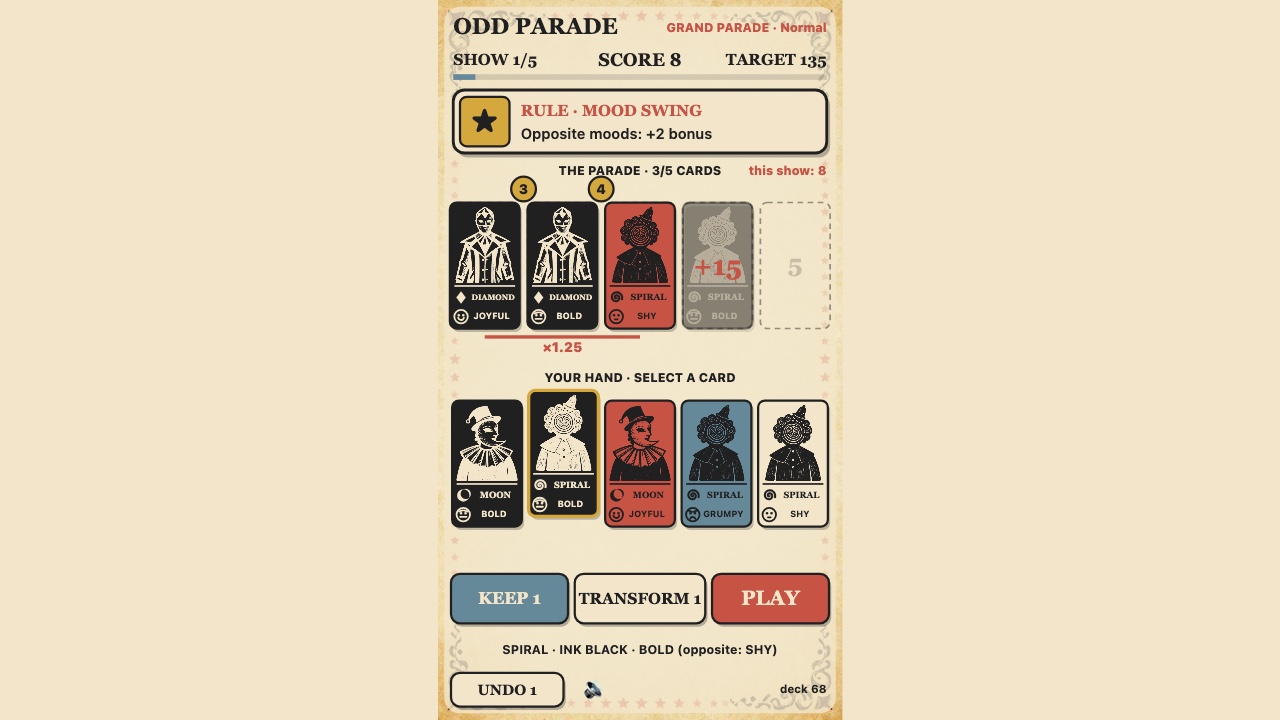
- Odd Parade uses a linocut print style, with masked performers rendered like carved ink lines on paper.
- A new show rule arrives after every move, which changes how the following card is scored.
- Scoring comes from matching masks, opposite moods, and changing colors, and chained patterns multiply rather than reset.
- The game includes five acts, three difficulty levels, and a daily parade that uses an identical setup for every player.
If a card puzzle is not the mood you are in, the full game library holds arcade and action titles that load just as fast.
What Is the Odd Parade Game?
Odd Parade is a free browser card game in which each show is a row of five masked performers scored on masks, moods, and colors.
It looks like a stack of hand-carved prints someone left on a table. The performers wear masks, the outlines are rough on purpose, and the palette stays close to ink and paper.
Under that surface sits a card game with a tight scoring loop. You place one performer at a time, and every placement changes what the next one is worth.
The show is five cards wide. Fill that row well and the patterns pay out. Fill it carelessly and you have spent cards that could have done more somewhere else.
Everything happens in the browser. No download step, no sign-up screen, no payment prompt between you and the first hand.
How Scoring Works: Masks, Moods, and Colors
Points come from three readings of the row — matching masks, opposite moods, and shifting colors — and chained patterns multiply instead of resetting.
Three things score, and they read the same five cards in different ways. Matching masks pay. Opposite moods also pay, which surprises people who assume a pair of identical faces is always the target.
Changing colors are the third thread. As the line grows, color shifts add their own value on top of whatever the masks and moods are already doing.
Chains are where the numbers climb. When one scoring pattern feeds the next, the multiplier stacks rather than starting over, so the order you play in matters as much as the cards themselves.
That tension shows up in almost every hand. Lock a safe match now, or hold the card back and set up a longer chain two placements later. Most losses come from choosing too early.
A New Show Rule After Every Move
After each move a new show rule arrives, and it reshapes how the next placement is scored.
The rule drop is the engine of the game. Every time you place a performer, a fresh condition lands on the show — sometimes nudging a value, sometimes changing what counts as a match at all.
Read it before you look at your hand. Players who plan first and read second tend to burn a good card on a rule that just made it ordinary.
Because the rule lands on every move, the same opening hand plays out differently each time. Nothing settles into a memorized sequence you can replay on autopilot.
Five Acts and Three Difficulties
Odd Parade is built as five acts with three difficulty settings, so the run is a body of work rather than one lucky show.
Each act behaves like a stretch of shows rather than a single round. Your score builds across them, which means one weak show can be recovered and one strong show can be wasted by a sloppy follow-up.
Three difficulty levels sit alongside the acts. The gentler ones give you room to learn how opposite moods behave. The harder ones tighten the rule changes and make loose placements cost more.
Start low and it is not a downgrade. It is reconnaissance. You want to see the scoring patterns settle in your head before the game starts squeezing your choices.
The Daily Parade, Same Cards for Everyone
The daily parade gives every player the identical setup on the same day, which makes scores directly comparable.
There is no personal seed and no reroll. The parade you open is the parade a friend opens, card for card, rule for rule.
That turns it into the best place to compare notes. If someone posts a bigger number, the deck was not kinder to them — the order they played was simply better.
It also suits a short session. One parade, one honest attempt at reading the rule correctly, then close the tab and get on with the day.
Free to Play on Phone, Tablet, or Desktop
Odd Parade plays free in the browser on phones, tablets, and desktops, with no login and nothing gated behind a payment.
Chances are you are reading this on a phone, and that is fine. The same address and the same rules carry across phone, tablet, and desktop, so a run started on the couch can be finished on a laptop.
Nothing is locked. There is no membership tier, no wall that halts a show halfway, and no password to keep track of. Open the page and the game begins.
When you want something different in the same tab, the site has arcade and action titles that load just as quickly. Nothing on the site charges, and nothing asks you to register first.
You can open Odd Parade in the same tab and start a show without installing anything.
Frequently Asked Questions
Is Odd Parade free to play?
Yes. Every show is open in the browser at no cost, and there is no account, subscription, or download involved.
How many performers go into a single show?
Five. The row is five masked performers wide, and all the scoring reads across that row.
Do I need to create an account or log in?
No. The page loads straight into a show and nothing asks you to sign up first.
What makes the daily parade different from a normal run?
The setup is identical for every player that day, so the scores people post are actually comparable.
Does the scoring rule change often?
After every single move. That constant shifting is why the order of your placements matters so much.